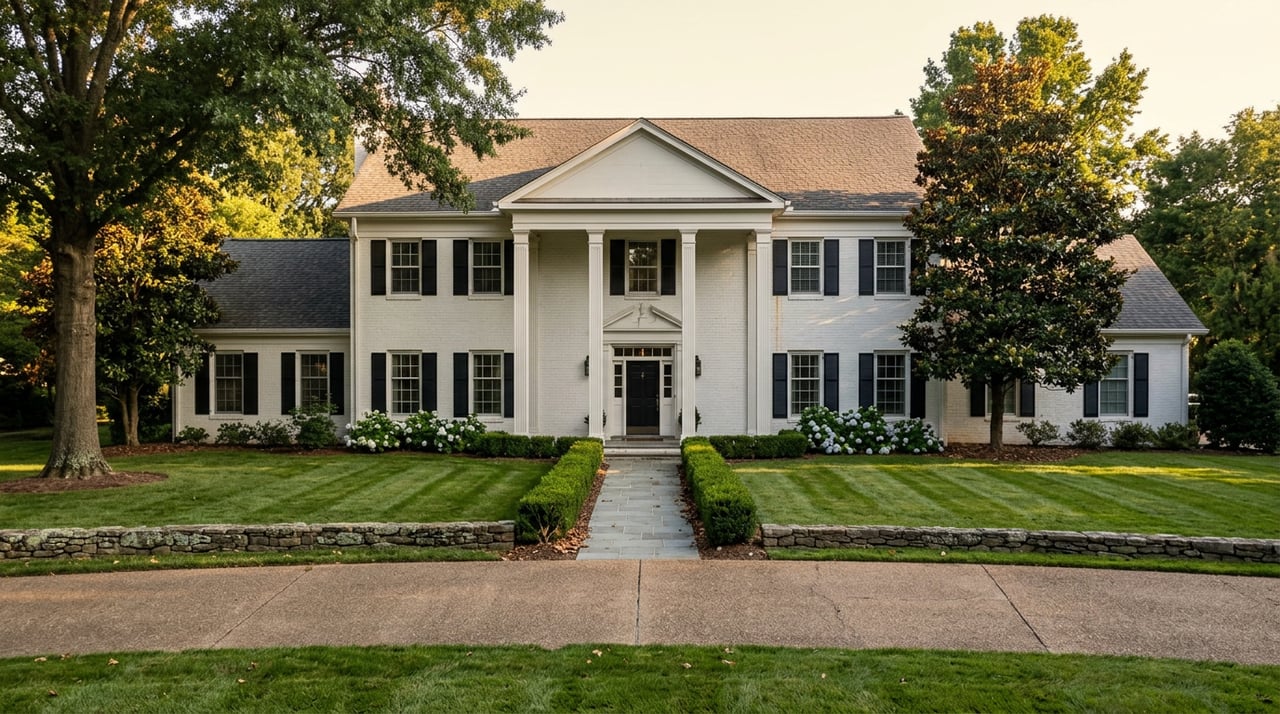
A buyer tells me their budget is $780,000 because that's the number they saw attached to Alpharetta on a home search site. They assume that number describes one market: a typical Alpharetta house, at a typical Alpharetta price, in a typical Alpharetta neighborhood. Then we tour three houses in one afternoon and the math stops making sense. A townhome a mile from Avalon lists for $420,000. A four-bedroom infill build off Old Milton Parkway lists for $1.1 million. A resale ranch on a half-acre in an older section of the city lists for $650,000 and needs work. None of these are outliers. They're the median.
That's the thing about Alpharetta right now: the citywide median isn't describing a market. It's averaging three markets that don't actually compete with each other for the same buyer, and depending on which one you're shopping in, "the market" behaves in almost opposite ways.
The number itself is unstable, and that's the tell
If you've been comparing sources online, you've probably noticed the median price for Alpharetta doesn't hold still. One tracker puts it near $792,000 for the three months ending in June 2026. Another shows Alpharetta's average home value sitting closer to $656,000 as of mid-2026. A third source pegs the median around $625,000 earlier in the year, with entry-level townhomes starting near $350,000.
These aren't typos or bad data. They're measuring different slices of a city that contains genuinely different housing products at genuinely different price points, and depending on which slice a given tracker weights more heavily, the citywide number swings by well over $100,000. That instability is itself the finding: when the median can't settle, it's usually because the market underneath it isn't one market.
Tier one: Avalon and the AlphaLoop corridor
Avalon, the 86-acre mixed-use district built out between 2014 and 2019, anchors one end of Alpharetta's price range, and it's the end most people picture when they think of the city's housing market even though relatively few Alpharetta homes actually sit inside it. Townhome sales tracked inside Avalon this year include a three-bedroom unit that closed at $1,362,500 in March 2026 and two four-bedroom units that closed at $1,350,000 and $2,100,000 in February 2026. As of this spring, Avalon townhomes on the market averaged well north of $2 million in list price.
New construction just outside Avalon's edge follows the same gravity. Foundry, a townhome community from John Wieland Homes positioned with direct access to the AlphaLoop, the trail connecting Avalon to downtown Alpharetta, has listed units between roughly $635,000 and $757,000. Uptown Rowe, a boutique collection of just sixteen English-inspired townhomes in downtown Alpharetta, is also built along the AlphaLoop and priced at a similar premium for the walkability.
This is a real estate agent's shorthand for the 30009 zip code, and it commands its premium for a specific reason: you're paying for the ability to walk to Avalon's retail and dining, or to downtown Alpharetta's city green, farmers market, and locally owned storefronts, without getting in a car. That's a lifestyle purchase as much as a housing purchase, and the price reflects it.
Tier two: established neighborhoods absorbing infill
A few miles from that corridor, a second market operates on a completely different logic. Established neighborhoods like Windward, The Manor Golf and Country Club, and Crooked Creek offer larger lots and mature landscaping, and builders are actively working the seams around them. Original ranch homes on half-acre lots are being replaced with new four- and five-bedroom homes priced for move-up buyers, a pattern playing out in Crabapple and similar older sections of the city. Single-family new construction in this tier generally starts around $650,000 for smaller-lot plans and extends past $1.2 million for custom and semi-custom builds, a considerably wider range than the walkable corridor's townhome-dominated pricing.
The buyer in this tier isn't paying for a five-minute walk to a restaurant. They're paying for square footage, yard space, and an established street, and they're competing against other move-up families rather than against downtown lifestyle buyers. It's a different competitive set with a different ceiling, and treating it as the same market as Avalon is where a lot of budget confusion starts.
Tier three: the entry point near the employment core
The third tier is the one portal medians tend to undercount because it moves fastest and turns over in volume rather than headline price. Townhome projects near Avalon and along the Windward Parkway corridor attract buyers who want walkability and low-maintenance living in the $500,000 to $700,000 range, while smaller communities like Byers Park, a 24-lot townhome development off Old Milton Parkway about a mile from Avalon, and IveyBrooke, an 85-unit townhome community, are built specifically for buyers who can't or don't want to compete for the larger single-family stock. This is the segment absorbing entry-level buyers and young professionals priced out of detached homes, and it's the closest thing Alpharetta has to a starter market, even though "starter" here still often clears $400,000.
| Tier | Product | Approximate range | Who's competing |
|---|---|---|---|
| Avalon / AlphaLoop corridor | New townhomes, luxury resale | $635,000 to $2.1M+ | Walkability-first lifestyle buyers |
| Established neighborhoods | Infill single-family, move-up new construction | $650,000 to $1.2M+ | Move-up families, larger lots |
| Employment-core townhomes | Smaller lot townhome communities | $400,000 to $700,000 | First-time and relocating buyers |
The leverage shift the median doesn't show
Underneath all three tiers, something else has changed this year that a single price figure can't capture: who has the upper hand in negotiation. Over the three months ending in June 2026, homes in Alpharetta were taking an average of 29 days to sell, up from 25 days the year before, and selling for a median 4.3 percent below the same period last year. Separately, as of January 2026, only 11.86 percent of Alpharetta homes sold over asking price, down sharply from 21.5 percent the year prior, and the sale-to-list ratio had slipped to 96.61 percent, a level that favors buyers rather than sellers.
None of this describes a downturn. Inventory sits at a healthy but not flooded level, homeowner equity remains substantial, and the fundamentals that drove Alpharetta's growth, corporate campuses along the GA-400 corridor and steady relocation demand, haven't gone anywhere. What it describes is a market quietly rebalancing after a run of sellers holding most of the leverage. For a buyer, that means a well-priced home in any of the three tiers above is worth pursuing with a real offer rather than an anxious one. For a seller, it means the days of listing high and expecting a bidding war to fix the price are, for now, over.
What this means if you're comparing Alpharetta to somewhere else
If you're weighing Alpharetta against another north metro suburb, the honest answer is that "Alpharetta's price" depends entirely on which of these three markets you're actually shopping. A relocating professional targeting walkability will pay a premium that has nothing to do with square footage. A move-up family targeting an established neighborhood is buying into infill competition and larger lots at a meaningfully lower price per square foot than the corridor commands. And a first-time buyer working the townhome segment near the employment core is competing in the fastest-moving, most volume-driven piece of the market, where the "median" undersells how much inventory is actually turning over.
None of the three medians reported this year is wrong. They're just describing different rooms in the same house.
A few questions worth asking before you set a budget
Is Alpharetta's market currently favoring buyers or sellers? The data through the first half of 2026 points toward a market in transition, with days on market rising and fewer homes selling over asking, though it stops well short of a buyer's market in the traditional sense.
Why do I see such different median prices for the same city? Because trackers weight the three tiers, Avalon-corridor townhomes, established-neighborhood single-family, and entry-level townhomes near the employment core, differently, and each tier moves at a different price point and pace.
Is now a good time to buy in the established-neighborhood tier? With more inventory and softer sale-to-list ratios than a year ago, buyers targeting infill or resale product in neighborhoods like Windward or Crabapple have more room to negotiate than the headline median suggests.
If you're trying to figure out which of these three Alpharetta markets actually fits your budget and your priorities, that's exactly the kind of question worth a real conversation rather than another portal search. Kenna Daws has spent years watching these tiers move independently and can walk you through what your specific number actually buys right now.